Working Principle of the PRN10 Pirani Vacuum Gauge
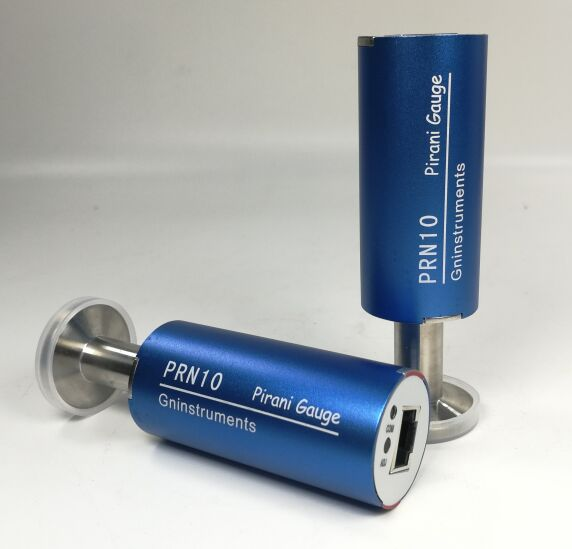
The PRN10, manufactured by Shanghai Cixi Instruments Co., Ltd., is a compact and exquisite Pirani vacuum gauge.
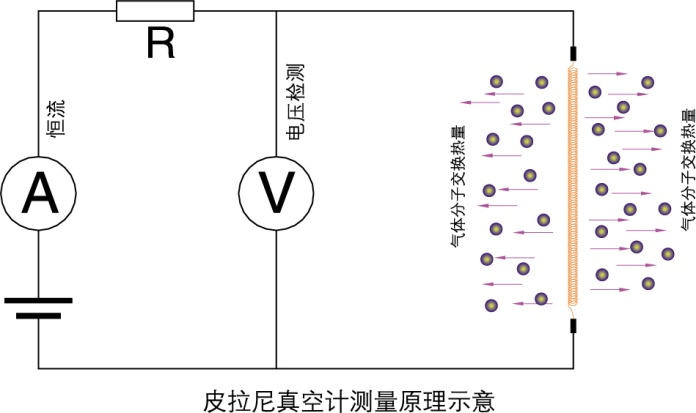
The working principle of the Pirani vacuum gauge is as follows: When a constant current (I) flows through a high-temperature resistant filament (resistance R), the filament heats up. The heat (Q) is exchanged with the surrounding environment in three ways:
1. Gas molecules collide with the filament, carrying away heat Qg.
2. Thermal radiation dissipates heat Qr.
3. Thermal conduction through the solid generates heat QSt. Therefore, in equilibrium, the following formula holds: Q = 1/2R = Qg + Qr + Qs. In engineering design, the following conditions must be met: the mean free path of the gas is much larger than the
diameter of the filament; the ambient temperature remains constant; and the filament temperature control remains constant. Theoretically, we can derive:
1/2R = AP + 10/2R
A = n(T - T0)
10 is the filament current when the pressure is at the lower limit of measurement, which compensates for heat loss due to solid thermal conduction and thermal radiation. T and T0 represent the filament temperature and ambient temperature, respectively,
and A is an engineering constant representing the pressure at a given inch.
If the filament resistance R, current I, and engineering constant A are known, the pressure P can be calculated using the formula.
Advantages: Simple and reliable structure.
Disadvantages: Small dynamic range of sensing quantity near atmospheric pressure, fluctuating due to temperature influences.
The standard process connection for PRN10 is a KF16 vacuum flange. KF25 vacuum flanges can also be customized according to customer site requirements, or adapters can be used for installation. It can also be used in special hose applications.
In high-temperature or extreme areas, insulation and cooling measures are required, such as installing cold traps or baffles for cooling. If the vacuum chamber is unclean or contains moisture, a drying filter must be installed.
The PRN10 Pirani gauge vacuum gauge is commonly used in laboratories. The standard media are dry air and nitrogen. The Pirani gauge operates on a thermal conductivity principle, maintaining accurate measurements within a stable range except
for dry air and nitrogen. If the system uses solvent vapors, oil mist, acid or alkali gases, or other reaction vessel media, the CFG500 Capacitance Film Vacuum Gauge can be selected. This type of gauge maintains measurement accuracy at each point
in different gases, and its accuracy is unaffected by gas pressure and temperature.
The PRN10 Pirani gauge uses SS316L stainless steel for its vacuum contact material, and its data acquisition resolution is 1%. The Pirani gauge has a response time of <100ms, an optimal measurement range of 10000~0.1Pa, and a scientific notation
of 1.0×10⁻¹ - 1.0×10⁺⁴ Pa.
Alternative models for Edwards (UK), MKS (USA), Leybold (Germany), Pfeiffer (Germany), and Inficon (Germany) include M-350PG-SD/N25, 275400-2-GE-T, 925-11480-0059, APG100-XLC, APG-MP-NW16 ST/ST, TTR91N, TTR96S, YR 20, TPR270
DN 16 ISO-KF, TPR280, and PSG500.
The probe of the PRN10 Pirani gauge is highly susceptible to impact. Rough handling during transport, accidental drop, or forceful bending during installation can render the probe unusable. Furthermore, the presence of steam, oil mist, or particles in the
tubing during use can gradually accumulate around the heating wire and probe over time. If the PRN10 Pirani gauge becomes contaminated, due to its thermal conductivity principle, the heat signal cannot be properly transmitted to the gas, altering the
equivalent thermal resistance and heat dissipation path, ultimately affecting the measurement.
The Pirani gauge works by heating a metal wire or heating element in a vacuum and observing its heat dissipation to deduce the pressure of the surrounding gas. Air is typically used during production calibration, and the relationship between heating
power and temperature/pressure is predictable and calibrable within a certain temperature range. However, reactive gases may exhibit drift. For reactive gases, it is recommended to use another product from Shanghai Cixi Instruments Co., Ltd.
the
CFG500 Capacitance Film Vacuum Gauge.
If you would like to learn more about Pirani vacuum gauge selection and pricing, please contact CIXIFM Winny:
WhatsApp: 008618049841995
